FCC Physics Community Convenes as Feasibility Report Anchors the Scientific Vision
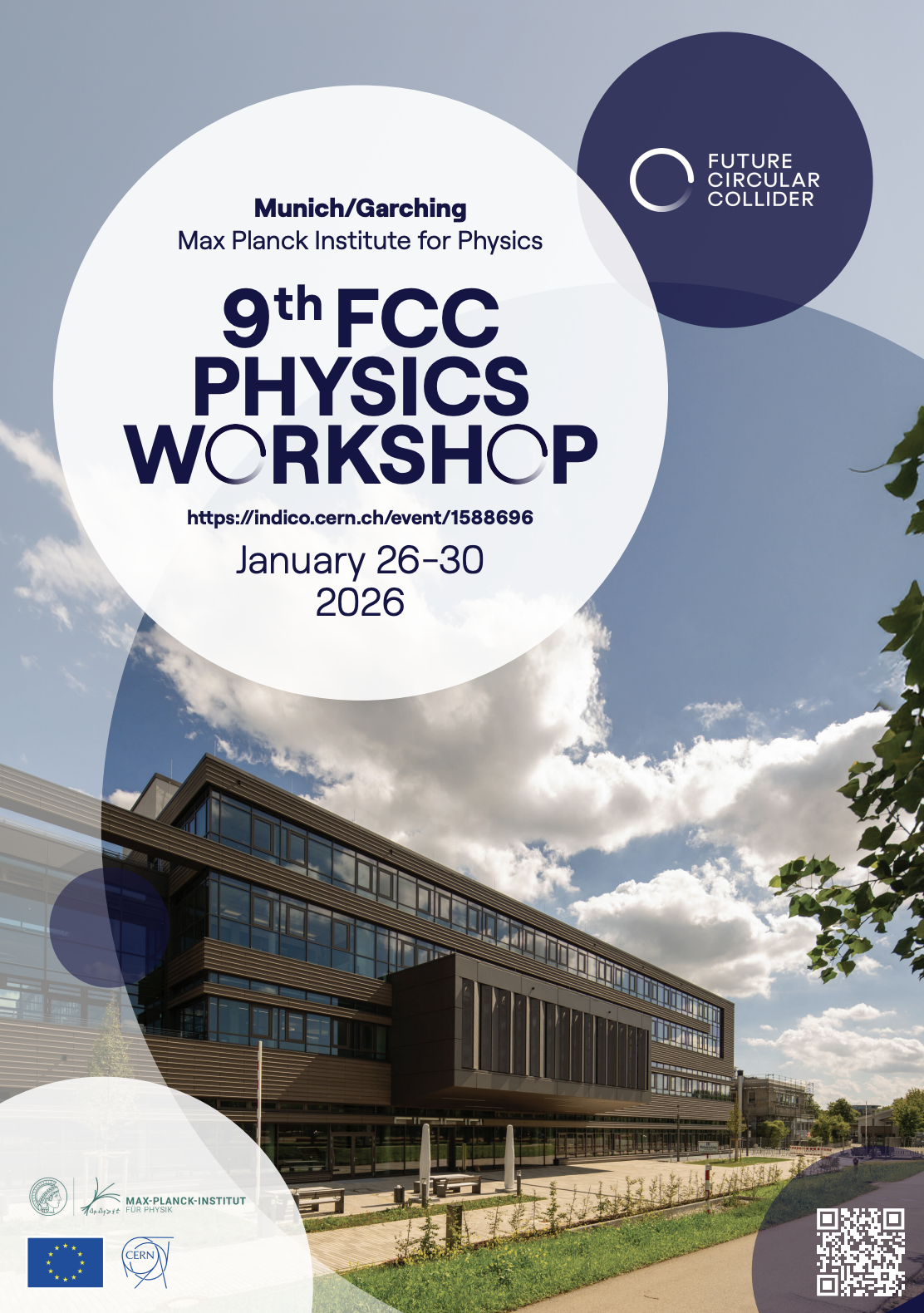
The upcoming 9th FCC Physics Workshop (26–30 January 2026, Munich-Garching) comes amid major scientific milestones for the Future Circular Collider (FCC) initiative. Most prominently, Volume 1 of the FCC Feasibility Study Report — “Physics, Experiments, Detectors” — has been published in European Physical Journal C, providing a comprehensive, peer-reviewed foundation for the FCC physics programme and experimental design.
This landmark publication reviews the physics case, lays out the experimental opportunities offered by a staged FCC implementation (starting with a high-luminosity electron–positron collider FCC-ee, and extending to a high-energy proton–proton collider FCC-hh), and summarises detector concepts and performance benchmarks that will enable precision measurements and searches for new phenomena well beyond the reach of the High-Luminosity LHC.
Complementing this foundational report, the recently released FCC physics manifesto synthesises core lessons from the feasibility study and other community efforts, condensing them into a coherent scientific vision that has informed the European Strategy for Particle Physics Update 2025–2026. This manifesto offers a concise articulation of the physics priorities — from precision Higgs and electroweak measurements to wide-ranging probes of physics beyond the Standard Model — that underpin the community’s case for the FCC.
Against this backdrop, the upcoming FCC Physics Workshop serves as a timely platform for discussion: researchers are tracing connections between the detailed physics and detector assessments in the Feasibility Report and the strategic, community-wide directions captured in the manifesto. With dedicated sessions — including a strong emphasis on early-career participation — the workshop will reflects both the scientific maturity of the FCC programme and will discuss the continuing evolution in response to global research priorities in particle physics.